Part 6 – Data Center Load & Grid Resilience: Planning, Risk, and Mitigation

In this sixth installment of our seven-part series on data centers and their impact on the grid, we focus on one of the most pressing issues for utilities and metering professionals — how large, concentrated loads affect grid resilience and planning.

If you haven’t read the earlier parts, start here:

Why the Data Center Boom Matters for Grid Resilience

Data centers are unlike any other industrial load. They require tens to hundreds of megawatts of continuous power, operate 24/7, and often appear in clusters, concentrating demand on specific feeders and substations.

  • According to the U.S. Department of Energy, U.S. data centers consumed about 4.4 % of total electricity in 2023, a figure expected to double by 2028. (DOE Report)
  • A recent Utility Dive analysis estimates that data centers could account for 44 % of U.S. load growth from 2023–2028.
  • As Canary Media put it, “Utilities are flying blind on data center demand.” (Read more)

For metering and grid operations, this means unrelenting demand, tight reliability requirements, and a growing need for real-time visibility into load profiles.

Planning Challenges for Utilities and Metering Professionals

Forecast Uncertainty

Data center developers move fast — often faster than traditional utility planning cycles. Load forecasts can be off by tens of megawatts if a hyperscaler changes its plans, leaving utilities scrambling to adapt.

Infrastructure Growth and Cost Allocation

Serving these mega-loads can require new substations, feeders, and transmission capacity. Traditionally, these costs are spread across all ratepayers, but that’s increasingly controversial.

“Because data centers consume so much power, utilities are building billions of dollars of new power lines and power plants to supply these industrial-scale facilities.” — Harvard Law Today

Grid Resilience and System Stress

Continuous, non-interruptible loads stress transformers, feeders, and switchgear, reducing system flexibility. Harmonics from server equipment can also degrade power quality and cause metering accuracy issues.

Metering and Data Visibility

Accurate, high-resolution data is vital. Advanced metering must capture 15-minute or shorter intervals, power factor, harmonics, and voltage disturbances — all essential for billing, planning, and equipment health.

(For more on AMI and interval metering, see Advanced Metering Infrastructure and Automated Meter Reading: Deep Dive)

Risk Factors for Utilities and Ratepayers

Stranded Asset Risk

If a utility invests heavily in capacity for a proposed data center that’s later delayed or canceled, those assets may become underutilized — costs that often fall back on ratepayers. (Volts.wtf)

Cost Shifting

Analysts estimate that data center growth could raise residential bills by about 1 % annually through 2032 as infrastructure costs are spread systemwide. (Utility Dive)

Rate Shock & Political Pushback

Sudden increases in bills can lead regulators to pause or restrict data center projects, as seen in several U.S. states. (Stateline.org)

Power Quality Concerns

Heavy harmonics and reactive power demand can impact neighboring customers, degrade transformer life, and distort billing data — making metering validation and harmonics monitoring critical.

Mitigation Strategies for Metering and Grid Teams

StrategyDescription
Advanced MeteringDeploy interval meters (≤15 min) with real-time communication and PQ (power quality) measurement.
Special Rate ClassesEstablish large-load tariffs with minimum billing commitments and shared infrastructure costs.
Scenario PlanningModel different load outcomes and stress scenarios, including curtailment and relocation risk.
Demand Response IntegrationEncourage data centers to provide flexibility through controlled curtailment or battery backup systems.
Transparent Cost RecoveryPublicly document how large-load infrastructure costs are assigned to protect public trust.
Cross-department CoordinationAlign metering, planning, and regulatory teams on large-load connection standards.

Practitioner Checklist

  • Interval metering (≤15 min)
  • Power quality and harmonics monitoring
  • Real-time communication to AMI or SCADA
  • Large-load rate review and interconnection agreement
  • Transformer/feeder capacity analysis
  • Scenario planning and curtailment protocols
  • Stakeholder and ratepayer communication plan

Key Takeaways

  • Data centers are system-scale loads, not just industrial customers.
  • Metering teams play a central role in visibility, billing accuracy, and planning support.
  • Utilities must rethink rate design, cost allocation, and flexibility incentives.
  • Early coordination and transparent planning can protect both grid resilience and ratepayer equity.

Coming Next: Part 7 – Metered Data, Advanced Tariffs, and Utility Business Models for the Data Center Era

We’ll close the series by exploring how utilities can use metered data, time-of-use rates, and advanced analytics to better serve data centers without overburdening the grid.
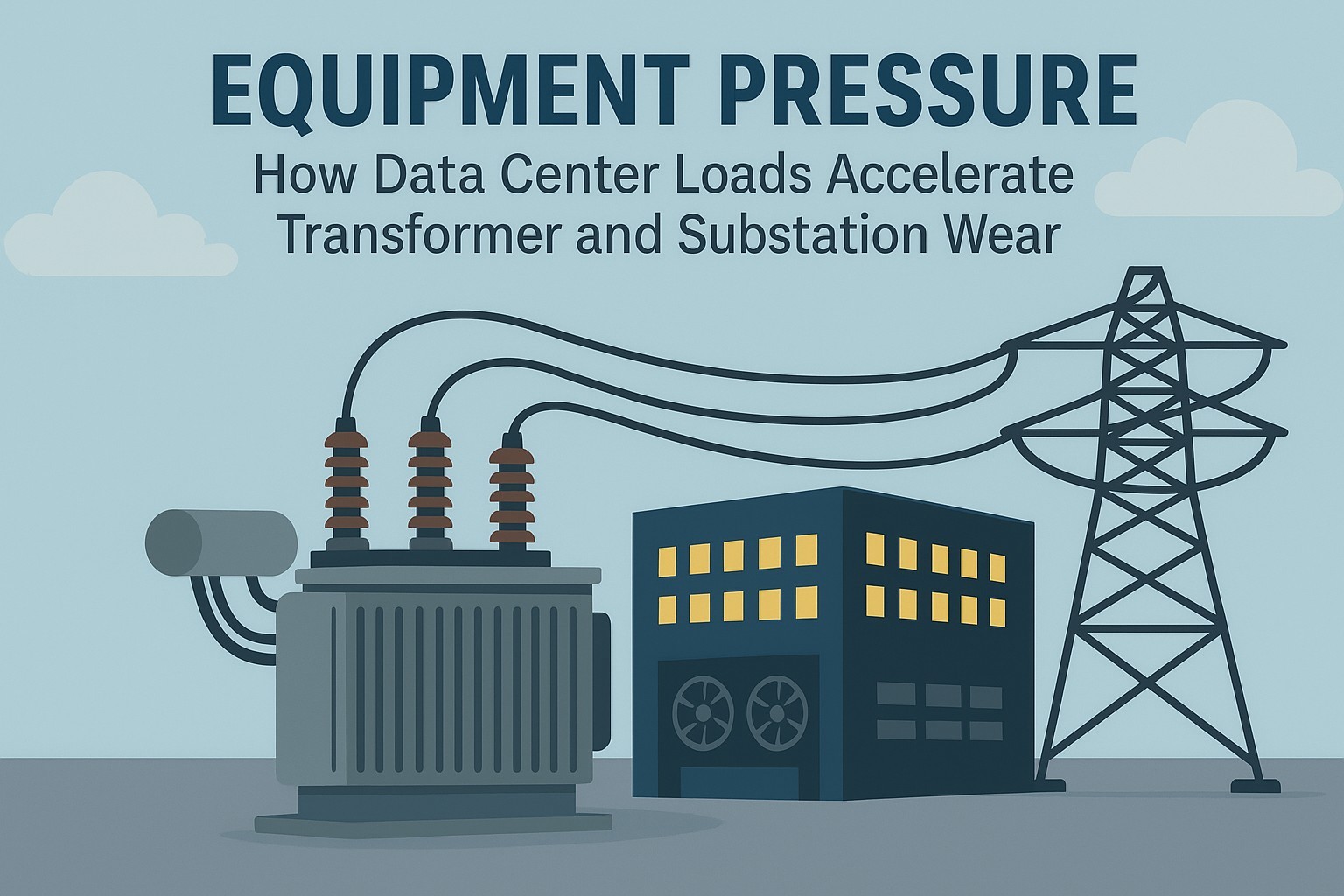
Data Centers – Part 5: Equipment Pressure: How Data Center Loads Accelerate Transformer and Substation Wear

In Part 5 of our 7-part series on data center impacts, we shift focus to the equipment itself—transformers, switchgear, breakers, relays, and other substation assets tasked with serving constant, high-load customers. These facilities place unique, sustained pressure on utility infrastructure that was often designed for more diverse and fluctuating loads.

Let’s explore the consequences—and the countermeasures.

Constant High Load = Accelerated Thermal Aging

Most transformers are rated for a diversified load profile, where usage fluctuates throughout the day. But data centers operate at near full load 24/7.

This causes:

  • Continuous heat stress on windings and insulation
  • Reduced lifespan for oil-filled transformers due to moisture and oxidation buildup
  • Higher risk of thermal overload in contingency (N-1) conditions

For technical background, review our guide on CTs and PTs to understand how sensing infrastructure ties into load protection.

Field Tip: Use thermal imagers like the Fluke TiS20+ Infrared Camera for monthly scans of substation and pad-mount equipment serving data centers.

Harmonics from UPS and Power Electronics

Uninterruptible power supplies (UPS), battery banks, and server clusters often inject harmonics into the distribution system.

The impact:

  • Excessive heating in transformer cores
  • Misoperation of protection relays
  • False alarms or failure in SCADA-monitored systems

Solution: Install filtering equipment or specify K-rated transformers for new installations.

To learn more about harmonics and their impact on equipment, check out our article on power quality monitoring in industrial systems.

Rapid Expansion = Planning Lag

Data centers grow fast. One 10 MW facility today could request an upgrade to 40 MW within two years.

The challenge:

  • Transformer banks are undersized if built to initial specs
  • Substations lack feeder redundancy
  • Asset life-cycle planning gets disrupted

The result? Deferred maintenance, short-lived equipment, and outage risk across shared infrastructure.

Best Practice: Use modular, scalable substation designs and include margin in load forecasting.

Asset Health Monitoring Is a Must

Utilities serving data centers should proactively deploy:

  • Online dissolved gas analysis (DGA) for transformers
  • Bushing temperature and current sensors
  • Circuit breaker health and contact-wear monitors

Products like the OMICRON MONTESTO 200 offer portable, real-time diagnostics.

Don’t Wait for Failure: Condition-based maintenance becomes critical when equipment is stressed around the clock.

Coordination with IT and Facility Ops

Substation reliability isn’t just about the utility side. Data center operators often have internal distribution gear and backup systems.

What utilities should do:

  • Share real-time SCADA visibility with critical facilities
  • Conduct regular joint switching and outage drills
  • Coordinate on overcurrent protection and breaker time-current curves

This reduces nuisance trips, improves incident response, and protects shared assets.

External Reading:

For a case study on the role of transformer health monitoring in data center-heavy grids, see: 🔗 Managing Grid Resiliency in Virginia’s Growing Data Corridor (Energy Central)

Internal Links

Conclusion

High-load facilities like data centers demand more than just more power—they demand smarter, more robust, and more closely monitored infrastructure. Utilities must adapt with a blend of condition-based maintenance, smart planning, and collaboration with operators.

Did you miss any part of this 7‑part series? See what you missed below.
Data Centers – Part 1: Understanding the Modern Data Center Load
Data Centers – Part 2: Infrastructure Stress: How Data Centers Are Forcing Grid Planning to Evolve
Data Centers – Part 3: Metering Data Centers: Challenges and Best Practices for Utility Accuracy
Data Centers – Part 4: Rate Design & Equity: Ensuring Cost Recovery for Data Centers without Burdening Other Ratepayers

Data Centers – Part 6: Data Center Load & Grid Resilience: Planning, Risk, and Mitigation

Data Centers – Part 4: Metering Data Centers: Challenges and Best Practices for Utility AccuracyRate Design & Equity: Ensuring Cost Recovery for Data Centers without Burdening Other Ratepayers

As data centers expand, utilities face a delicate balancing act: capturing the true cost of serving these mega-load customers while protecting the broader ratepayer base from subsidizing infrastructure upgrades. In Part 4 of our 7-part series, we navigate the evolving world of rate design, special tariffs, and regulatory challenges.

The Cost Causation Principle: Fundamentals and Friction

Regulatory frameworks expect customers to pay in alignment with the actual cost of serving them—transmission, distribution, maintenance, and metering. But when large infrastructure like transformers, substations, or even generation is built for one or two data centers, allocating costs becomes contentious.
As noted by Harvard researchers and reported in Utility Dive, “utilities may subsidize data center growth by shifting costs to other ratepayers.” Read article

Special Contracts and Custom Tariffs

Electric costs are one of the largest overhead expenses for data centers. As such, they are always looking for ways to reduce overhead expenses. Utilities are increasingly offering agreements to data centers, often involving:

  • Flat demand charges
  • Infrastructure cost recovery riders
  • Fixed monthly fees tied to MW capacity
  • Other long-term power purchase agreements

While these agreements help ensure revenue, they often operate behind closed doors, raising concerns about fairness, transparency, and regulatory oversight. Utilities need to be constantly aware of the potential impacts on existing customers.

Emerging Regulatory Pushback

States like Virginia and Texas are pushing back:

  • Virginia: Lawmakers are proposing special tariffs amid projections of data center energy use doubling.
  • Texas: Senate Bill 6 introduces planning standards and interconnection fees.

Policy & Rate-Design Strategies

Strategies utilities are using to protect system equity:

ChallengeRate SolutionBenefits
Mega-load cost recoveryDedicated rate class or capacity riderAvoids cost-shift to general base
Ratepayer equityPublished tariffs and transparent dealsBuilds trust and regulatory acceptance
Speculative projectsInterconnection depositsReduces ghost load inflation

Also, check out these deeper dives:

The Utility–Data Center Partnership Model

Examples of new hybrid rate/partnership approaches:

  • Clean energy tariffs
  • Demand response agreements
  • Co-investment in infrastructure

Conclusion

Data centers aren’t just major electricity users—they’re catalysts for rate structure evolution. Whether through special tariffs, dedicated classes, or advanced partnership models, utilities must strike a balance: recover costs fairly, enable infrastructure growth, and protect everyday consumers.

Did you miss any part of this 7‑part series? See what you missed below.

Data Centers – Part 3: Metering Data Centers: Challenges and Best Practices for Utility Accuracy

In Parts 1 and Part 2 of this series, we covered the unique characteristics of data center loads and their growing strain on utility infrastructure. In Part 3, we focus on the metering side of these massive energy users. Because data centers operate 24/7 with redundant systems and backup power, metering and billing accuracy can get complicated—fast.

Here’s how utilities and metering professionals can stay on top of it.

Dual Feeds and Redundancy: Two Meters or One?

Most large data centers demand redundant utility feeds to maintain uptime. This introduces multiple metering setups:

  • Option 1: Two independent meters on each feed, summed at billing
  • Option 2: A single master meter downstream of the failover switchgear

Best Practice: Keep meters on each feed and monitor both with your AMI system. This allows for fault detection, load profiling, and revenue assurance—even if one feed remains idle most of the time. In either case, make sure that both feeds have a meter so they can be monitored independently. It may also be helpful to meter each individual transformer. The more data, see what I did there, the better.

Review our AMI deep dive to understand how modern metering systems handle complex, multi-feed sites.

Backup Generation and Net Metering Complications

Data centers often employ:

Depending on your interconnection policies, backup generation can:

  • Backfeed into the grid during test cycles
  • Confuse meter readings during momentary switching
  • Violate net metering rules if not isolated properly

Recommendation: Install revenue-grade meters with anti-backfeed capabilities or configure metering CTs with logic that ignores generation-only intervals.

Tools like the Fluke 1777 Power Quality Analyzer can help verify load versus generation during commissioning.

Load Profiles and Billing Precision

Constant loads can hide subtle but important changes in usage. Metering professionals should look for:

  • Gradual increases in baseline kWh demand over months (growth signal)
  • Load drops that may indicate system switching or failure
  • Harmonic signatures from new UPS equipment or cooling loads

Tip: Use AMI interval data to detect unusual patterns. For training on usage breakdowns, review our Load Profile article.

Meter Forms and CT/PT Considerations

Most data centers are on primary metering schemes and require:

  • 9S meters for polyphase applications
  • Current transformers rated for >4000A in many cases
  • Potential transformers when primary voltages exceed meter voltage limits

You can refresh your understanding of these setups with our articles on Meter Forms and CTs and PTs.

Also consider the Fluke 376 FC Clamp Meter for safe CT current verification in the field.

Cybersecurity and Remote Metering Access

With data centers being critical infrastructure, utilities must ensure:

  • Secure transmission of meter data over encrypted channels
  • Controlled access to meter configuration and data pulls
  • Firewalls or data diode systems between utility networks and metering endpoints

If your AMI or SCADA system interfaces with data center meters, coordinate with the facility’s IT/security team for regular audits.

Conclusion

Metering a data center is more than dropping in a meter base. From dual feeds to UPS-induced harmonics, the complexity demands robust planning, accurate equipment, and coordination with operations and IT.

In Part 4, we’ll explore the rate design side of data centers—how utilities recover infrastructure costs and ensure rate fairness while serving these high-demand, high-expectation customers.

Explore More:

Further Reading: For a deeper dive into multi-node metering architectures and generation-aware metering strategies, check out LBNL’s Metering Best Practices guide.

Did you miss any part of this 7-part series? See what you missed below.

Data Centers – Part 2: Infrastructure Stress: How Data Centers Are Forcing Grid Planning to Evolve

In Part 1 of this series, we explored how modern data centers introduce constant, high-density loads that utilities must measure and monitor accurately. Now in Part 2, we look at how those same facilities are reshaping the physical infrastructure of the grid—and putting pressure on utility planning timelines and equipment availability.

The Spot Load Problem: When One Customer Equals a Substation

A single hyperscale data center can request 30 to 50 MW of capacity—equivalent to tens of thousands of homes. For many distribution systems, this is not just a large customer. It’s a whole new grid segment.

Planning Implications:

  • Transformer capacity must be scaled up, often to 20/27/33 MVA or higher
  • Substation bus and relay upgrades may be required
  • Feeder additions or reconductoring may stretch out years

Tip: Use your knowledge of CTs and PTs to ensure meter and protection equipment are sized correctly for primary metering installations.

Equipment Procurement Delays

Transformer and switchgear lead times are now a major bottleneck. Some utilities report delays of 18–36 months for large power transformers and even basic pad-mounted gear. These delays ripple through system planning and economic development.

Recommendations:

  • Forecast equipment needs early using GIS and load modeling
  • Coordinate with suppliers and regulators to pre-order critical equipment
  • Consider modular or mobile substation solutions for interim service

For quick troubleshooting while awaiting permanent installations, utility professionals can use portable meters like the Fluke 1738 Three-Phase Energy Logger.

Land Availability for Substations and ROWs

Data centers often prefer inexpensive, flat land—which can be far from existing infrastructure. Even when land is available, right-of-way (ROW) approvals and permitting can delay builds by 1–2 years.

Utility Challenges:

  • Finding adjacent land for substations near data center campuses
  • Siting transmission lines or new feeders in rapidly urbanizing areas
  • Navigating zoning boards, environmental reviews, and public resistance

Many utilities are working with local governments and planning commissions to pre-zone and earmark potential substation sites in growing tech corridors.

Grid Resilience and Redundancy Requirements

Data centers typically require dual-feed redundancy for uptime guarantees. This means:

  • Loop-fed designs or networked substations
  • Relay coordination for backfeed scenarios
  • Complex SCADA integration and switching schemes

Learn how advanced metering systems support this complexity in our article on Advanced Metering Infrastructure.

Planning Across Jurisdictions

Larger data center builds often straddle service territories or affect upstream transmission-level infrastructure. Coordination becomes critical.

Best Practices:

  • Establish regional planning committees that include utilities, municipalities, and large-load developers
  • Standardize processes for large-load interconnection studies
  • Adopt flexible interconnection tariffs that encourage early communication

Conclusion

The pace and scale of data center growth are unlike anything utilities have seen before. Infrastructure that once took decades to plan must now be developed in just a few years. For metering and utility professionals, the key is early engagement, realistic forecasting, and collaborative planning.

In Part 3, we’ll zoom in on the metering side of data center integration—addressing how to monitor redundant feeds, handle backup generation, and ensure billing accuracy across complex load profiles.

Explore More:

Did you miss any part of this 7-part series? See what you missed below.

Data Centers – Part 1: Understanding the Modern Data Center Load

This is the first part of our series on data centers and their impact on the grid. Data centers are no longer niche facilities tucked away in remote corners of the utility map. They are massive, power-hungry, and critical to modern life. Whether it’s a hyperscale facility operated by a global tech company or a colocation center serving regional businesses, these facilities represent a new class of electric customer with unique characteristics.

For utilities and metering professionals, understanding the profile of a data center load is essential to planning, metering, and billing accurately. Let’s take a closer look at what makes these loads different and what that means for the grid.

High-Density, High-Duty Loads

Unlike residential or commercial customers whose loads vary based on time of day or season, data centers run nearly constant 24/7 loads. Servers, cooling systems, backup power, and network gear all operate continuously. Load factors can exceed 90% in some cases.

These are not just big loads—they are unrelenting.

Typical Characteristics:

  • Power demand often in the 5-50 MW range per facility
  • Minimal seasonal variation
  • High power factor (sometimes leading, depending on UPS systems)
  • Low diversity, which can complicate feeder balancing

Localized Impact: Spot Loads on the System

Data centers are usually built for rapid deployment. A rural substation that comfortably served scattered residential customers may suddenly face a 30 MW spot load request from a data center.

This puts strain on transformers, feeders, and upstream substation equipment.

If your team is dealing with transformer upgrades, you may want to revisit our guide on CTs and PTs to ensure the meter setup is scalable and accurate.

Pro Tip: Utilities should model spot loads using updated load forecasting tools and include them in long-term IRPs (Integrated Resource Plans).

Backup Generation and Redundancy

Most data centers use backup generators or battery systems (like UPS and even on-site battery energy storage). These often require dual feeds, with one as primary and another for failover. This introduces metering complexity:

  • Does each feed have a dedicated meter?
  • How are outages, transfers, and self-generation handled?
  • Are revenue-grade meters used?

You can brush up on the differences between meter forms and applications in our Meter Forms article.

For field technicians, a clamp-on CT like the Fluke 376 FC is helpful for quick diagnostics when working on high-current panels.

Harmonics, Power Quality, and Heat

Because data centers use large banks of switch-mode power supplies and cooling fans, they can introduce harmonics and power quality issues. That can lead to:

  • Transformer overheating
  • Neutral conductor overload
  • Metering inaccuracies if not properly filtered

Smart meters and PQ monitors like the Fluke 435 Series II can help identify distortion and transients.

Metering and Billing Considerations

Constant loads simplify some aspects of metering but complicate others:

  • Demand Charges: Since load doesn’t vary much, demand ratchets may unfairly penalize or underbill depending on rate design.
  • TOU Rates: Traditional time-of-use pricing may not incentivize much shift if data centers can’t vary load.
  • Remote Monitoring: AMI systems with robust data retention are key for reconciling large, complex usage patterns. Learn more in our deep dive on Advanced Metering Infrastructure.

Conclusion

The data center is a modern-day utility wildcard. For metering professionals, understanding how these loads operate, how they stress the system, and how to meter them accurately is essential to ensuring revenue accuracy and grid reliability.

In Part 2, we’ll look at how data centers influence infrastructure planning and why transformer, feeder, and land availability have become hot-button issues for utilities nationwide.

Explore More:

Did you miss any part of this 7-part series? See what you missed below.