


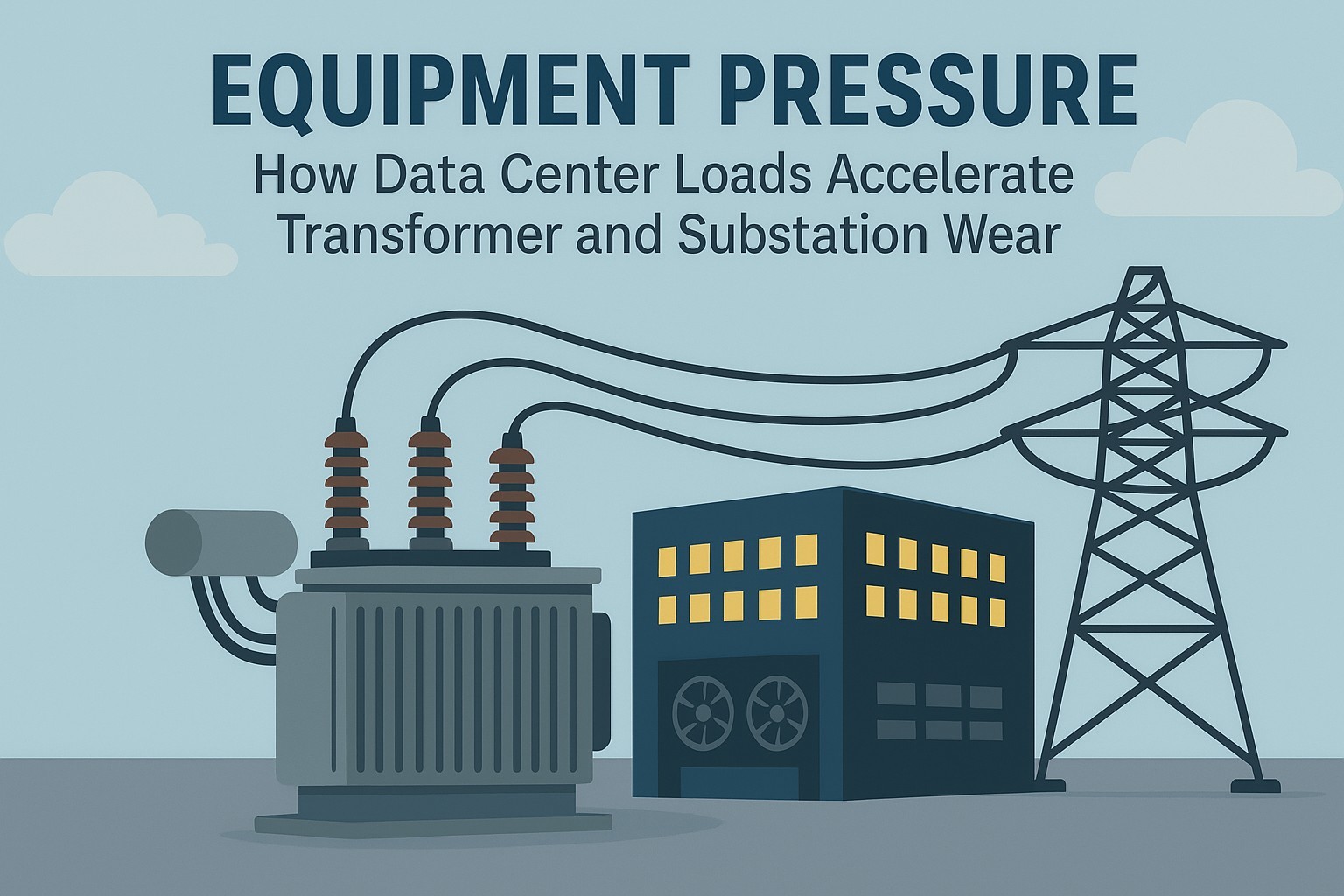
In Part 5 of our 7-part series on data center impacts, we shift focus to the equipment itself—transformers, switchgear, breakers, relays, and other substation assets tasked with serving constant, high-load customers. These facilities place unique, sustained pressure on utility infrastructure that was often designed for more diverse and fluctuating loads.
Let’s explore the consequences—and the countermeasures.
Constant High Load = Accelerated Thermal Aging
Most transformers are rated for a diversified load profile, where usage fluctuates throughout the day. But data centers operate at near full load 24/7.
This causes:
- Continuous heat stress on windings and insulation
- Reduced lifespan for oil-filled transformers due to moisture and oxidation buildup
- Higher risk of thermal overload in contingency (N-1) conditions
For technical background, review our guide on CTs and PTs to understand how sensing infrastructure ties into load protection.
Field Tip: Use thermal imagers like the Fluke TiS20+ Infrared Camera for monthly scans of substation and pad-mount equipment serving data centers.
Harmonics from UPS and Power Electronics
Uninterruptible power supplies (UPS), battery banks, and server clusters often inject harmonics into the distribution system.
The impact:
- Excessive heating in transformer cores
- Misoperation of protection relays
- False alarms or failure in SCADA-monitored systems
Solution: Install filtering equipment or specify K-rated transformers for new installations.
To learn more about harmonics and their impact on equipment, check out our article on power quality monitoring in industrial systems.
Rapid Expansion = Planning Lag
Data centers grow fast. One 10 MW facility today could request an upgrade to 40 MW within two years.
The challenge:
- Transformer banks are undersized if built to initial specs
- Substations lack feeder redundancy
- Asset life-cycle planning gets disrupted
The result? Deferred maintenance, short-lived equipment, and outage risk across shared infrastructure.
Best Practice: Use modular, scalable substation designs and include margin in load forecasting.
Asset Health Monitoring Is a Must
Utilities serving data centers should proactively deploy:
- Online dissolved gas analysis (DGA) for transformers
- Bushing temperature and current sensors
- Circuit breaker health and contact-wear monitors
Products like the OMICRON MONTESTO 200 offer portable, real-time diagnostics.
Don’t Wait for Failure: Condition-based maintenance becomes critical when equipment is stressed around the clock.
Coordination with IT and Facility Ops
Substation reliability isn’t just about the utility side. Data center operators often have internal distribution gear and backup systems.
What utilities should do:
- Share real-time SCADA visibility with critical facilities
- Conduct regular joint switching and outage drills
- Coordinate on overcurrent protection and breaker time-current curves
This reduces nuisance trips, improves incident response, and protects shared assets.
External Reading:
For a case study on the role of transformer health monitoring in data center-heavy grids, see: 🔗 Managing Grid Resiliency in Virginia’s Growing Data Corridor (Energy Central)
Internal Links
Conclusion
High-load facilities like data centers demand more than just more power—they demand smarter, more robust, and more closely monitored infrastructure. Utilities must adapt with a blend of condition-based maintenance, smart planning, and collaboration with operators.
Did you miss any part of this 7‑part series? See what you missed below.
Data Centers – Part 1: Understanding the Modern Data Center Load
Data Centers – Part 2: Infrastructure Stress: How Data Centers Are Forcing Grid Planning to Evolve
Data Centers – Part 3: Metering Data Centers: Challenges and Best Practices for Utility Accuracy
Data Centers – Part 4: Rate Design & Equity: Ensuring Cost Recovery for Data Centers without Burdening Other Ratepayers
Data Centers – Part 6: Data Center Load & Grid Resilience: Planning, Risk, and Mitigation